
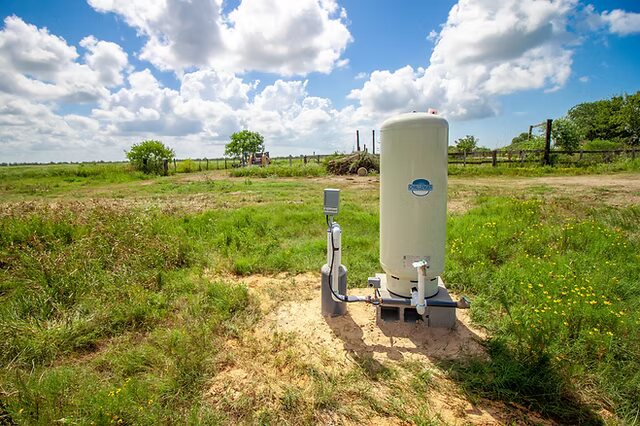
Wells and Septic on Rural Burleson County Land
Out in the county you are usually on your own well and your own septic. Here is how each one works, who permits it, and what I have buyers test before they close. Plain English, with the local agencies named.
Brazos Valley Living·Guides·Wells and Septic
← Back to GuidesMost rural Burleson County tracts have no city water or sewer. You draw water from a private well, usually into the Carrizo-Wilcox aquifer, and you handle wastewater with an on-site septic system. Depth and yield vary by site, so test an existing well's flow and quality before you rely on it. A septic system needs a permit from the Burleson County Environmental Office, the TCEQ's local authorized agent, after a soil evaluation. Here is how both work, and what I have buyers verify before closing.
Why I walk every land buyer through this
When you buy a finished house in town, water and sewer are someone else's problem. Out on rural land around Burleson County, and the rest of the Brazos Valley, they are yours. The tract either already has a working well and septic system, or you will be paying to drill and install both, and those are real costs and real timelines. I want you to know which situation you are in before you write an offer, and I want you to use the option period to actually test what is there rather than assume it works. None of this is legal, engineering, tax, or lending advice. It is the lay of the land, so you know what to ask the county, the groundwater district, and your inspectors.
Where the water comes from
Most of rural Burleson County sits over the Carrizo-Wilcox aquifer, which the Texas Water Development Board lists as one of the state's nine major aquifers. It runs in a wide band from the Louisiana border to Mexico, northwest of and parallel to the Gulf Coast aquifer, and it supplies a lot of the domestic, municipal, and irrigation water across this part of Texas. The Carrizo-Wilcox is made up of several formations, and within it the Simsboro Sand holds some of the most massive water-bearing sands in the area. Sitting over a major aquifer is good news, but it is not a guarantee for any one tract. How deep you have to drill and how much water a well produces vary from site to site. That is why I treat well depth, flow rate, and water quality as things to test on the specific property, not numbers to assume. I do not quote a typical depth or cost, because the honest answer is that it depends on the site, and a local licensed driller is the person to give you a real estimate for a given tract.
Who drills it, and who you register with
In Texas, water well drillers and pump installers are licensed by the Texas Department of Licensing and Regulation (TDLR). A license is required to drill a water well and to install a pump, and after the work the licensed driller files a State of Texas Well Report. Under TDLR's rules, that report has to be delivered no later than the 60th day after the well is completed, deepened, or altered, electronically to the department, to the well owner, and to the groundwater conservation district where the well sits. So a properly drilled well should come with paperwork you can ask for.
That last recipient matters here, because Burleson County is inside the Post Oak Savannah Groundwater Conservation District, which covers Burleson and Milam counties. Under the district's rules, a well for domestic or livestock use that cannot produce more than 25,000 gallons a day is exempt from a drilling permit, but it still has to be registered with the district, and you register before drilling. Larger wells, or wells for other uses above the district's threshold, are non-exempt and need a district permit. The rules and thresholds can change, so confirm the current version with the Post Oak Savannah Groundwater Conservation District before you drill. For more on who owns the water and how Texas treats groundwater, see my FAQ on water rights on rural Texas land.
What I want tested before you close
If a tract already has a well, I want two things checked during your option period: how much it produces and what is in the water. Production is the flow rate, measured in gallons per minute, and it tells you whether the well can keep up with a household, livestock, or irrigation. Water quality is the lab test. At a minimum I want a bacteria test for total coliform and E. coli, and many buyers also test for nitrates, total dissolved solids, and pH. The CDC recommends testing a private well at least once a year for total coliform bacteria, nitrates, total dissolved solids, and pH, and a purchase is exactly the moment to run that baseline. If there is no well yet, treat drilling as a cost and a timeline, not a sure thing, and get a local licensed driller's estimate. I am glad to help you line up the test or the bids.
How on-site septic works, and who permits it
A septic system in Texas is officially an on-site sewage facility, or OSSF. The Texas Commission on Environmental Quality (TCEQ) sets the statewide rules for these systems under Title 30, Chapter 285 of the Texas Administrative Code, but it does not run the program tract by tract. Instead, it delegates that to local authorized agents. Under 30 TAC Section 285.10, an authorized agent is responsible for implementing the chapter in its area of jurisdiction and for enforcing the chapter and Chapter 366 of the Texas Health and Safety Code.
For unincorporated Burleson County, that authorized agent is the county. The Burleson County Environmental Office is the designated representative for the TCEQ, and it is where you apply. A person must hold a permit and an approved plan before constructing, altering, repairing, extending, or operating a system, and the county issues the license to operate only after the installed system passes its construction inspection. So the order is: design and permit first, install, inspect, then operate. You can reach that office at 100 W. Buck St., Suite 303, Caldwell, TX 77836, (979) 567-2360.
Soil evaluation, percolation, and the distances
Before a septic system is designed, the land gets a site and soil evaluation. A licensed site evaluator or professional engineer looks at the soil profile to decide what kind of system the ground can support, and where the soil class calls for it, a percolation test measures how fast water moves through the soil. Tight clay drains slowly and may push you toward a different, often more expensive, system, such as an aerobic system, than sandy loam would. This is part of why I do not let buyers assume a standard drainfield will work on every tract.
The rules also set minimum separation distances so the septic system and the water well do not interfere with each other. Under TCEQ's Table X at 30 TAC Section 285.91(10), a soil absorption system, the drainfield, has to sit at least 100 feet from a private water well, and a sewage treatment or holding tank at least 50 feet. Those distances can drop to 50 feet when the private well is properly cased and grouted, but the safe planning assumption is that the well and the drainfield each need real room. On a small or oddly shaped tract, those setbacks can shape where, and whether, a system fits, which is one more reason the soil evaluation comes early.
What I have buyers collect and check
Here is the checklist I work through during the option period on a tract with, or needing, a well and septic.
On the water side: if there is an existing well, test the flow rate and run a water-quality test, and ask for the State of Texas Well Report and the pump details. If there is no well, get a local licensed driller's estimate and confirm the registration or permit path with the groundwater district. On the septic side: ask for the existing OSSF permit and the license to operate, have the system inspected, and confirm with the Burleson County Environmental Office that the records are clean. For new construction: get the site and soil evaluation early, because it drives the system type and the budget. If you are weighing a barndominium build, my barndominium guide covers how these systems fit a new build, and these same steps apply.
What I see go wrong
A few I run into often. Assuming a tract over a major aquifer is a guaranteed water well: the Carrizo-Wilcox underlies the area, but yield still varies by site, so test. Skipping the water-quality test because the well runs: quantity and quality are two different questions. Assuming an old septic system is permitted: some older systems predate current records, so verify the permit and license to operate with the county rather than taking it on faith. Forgetting the setbacks on a small tract: the 100-foot well-to-drainfield distance can decide where a system fits. And drilling before registering with the groundwater district: the registration comes first. If you want to walk the kind of country I am describing, my Snook page is a good place to start.
Wells and septic, answered
01 Does rural Burleson County land have city water and sewer? +
Most rural tracts do not. Out in the county you are usually on a private water well for water and an on-site septic system for wastewater. The well typically draws from the Carrizo-Wilcox aquifer, and the septic system needs a permit from the Burleson County Environmental Office, the TCEQ's local authorized agent. Confirm what actually serves a specific tract before you count on either.
02 Who issues a septic (OSSF) permit in Burleson County? +
The Burleson County Environmental Office. The TCEQ regulates on-site sewage facilities statewide under 30 TAC Chapter 285, but it delegates day-to-day permitting to local authorized agents. Burleson County is the designated representative for its area, so you apply with the county before constructing, altering, or repairing a system, and the county issues the license to operate after the system passes its construction inspection.
03 Do I need a permit to drill a water well in Burleson County? +
Burleson County is in the Post Oak Savannah Groundwater Conservation District. A well for domestic or livestock use that cannot produce more than 25,000 gallons per day is exempt from a drilling permit, but it still has to be registered with the district before drilling. Larger or non-exempt wells need a district permit. The well must be drilled by a TDLR-licensed driller, who files the State of Texas Well Report. Confirm the current rules with the district.
04 What should I test before I close on land with a well and septic? +
Test the well's flow rate and water quality, including bacteria such as total coliform and E. coli, since depth and yield vary by site. Get the existing septic permit and license to operate, and have the system inspected. Get a site and soil evaluation, including a percolation test where the soil class calls for one, to confirm the soil can support the system you need. I help buyers line up these checks during the option period.
This guide is general information, not legal, engineering, tax, or lending advice. Well, septic, and groundwater rules change, and every tract is different. For your situation, confirm the current requirements with the Burleson County Environmental Office, the Post Oak Savannah Groundwater Conservation District, the TCEQ, and TDLR, and talk with a licensed driller, a registered site evaluator or engineer, and your lender or attorney as needed. I am glad to point you to the right office.
Sources I used
- The Carrizo-Wilcox as one of nine major Texas aquifers, its extent, and its uses: Texas Water Development Board, Major Aquifers of Texas, and the TWDB Carrizo-Wilcox aquifer description. The Simsboro Sand as a major water-bearing unit: TWDB Carrizo-Wilcox aquifer report (PDF).
- TCEQ statewide OSSF rules and the role of local authorized agents: TCEQ, On-Site Sewage Facilities (Septic Systems), and 30 TAC Chapter 285, including the delegation language at 30 TAC Section 285.10, Delegation to Authorized Agents.
- Minimum separation distances (100 feet drainfield to well, 50 feet tank to well, with reductions for a properly cased and grouted well): 30 TAC Section 285.91(10), Table X, Minimum Required Separation Distances for On-Site Sewage Facilities.
- Burleson County as the TCEQ-designated representative, the permit-before-construction and license-to-operate sequence, and the office address and phone: Burleson County Environmental Office, On-Site Sewage Facility permitting.
- TDLR licensing of water well drillers and pump installers, and the 60-day State of Texas Well Report deadline: TDLR, Water Well Drillers and Pump Installers, and 16 TAC Section 76.70, Responsibilities of the Licensee, State Well Reports.
- Burleson County's groundwater district, and the exempt domestic and livestock well registration threshold (25,000 gallons per day): Post Oak Savannah Groundwater Conservation District, and its well applications and registration forms. Thresholds and rules should be confirmed current with the district.
- Recommendation to test private wells regularly for bacteria, nitrates, total dissolved solids, and pH: CDC, Guidelines for Testing Well Water.
Looking at rural land with a well and septic?
Tell me the tract you are considering and I will help you line up the water test, the septic records, and the soil evaluation, and point you to the county and the groundwater district, before you make an offer.